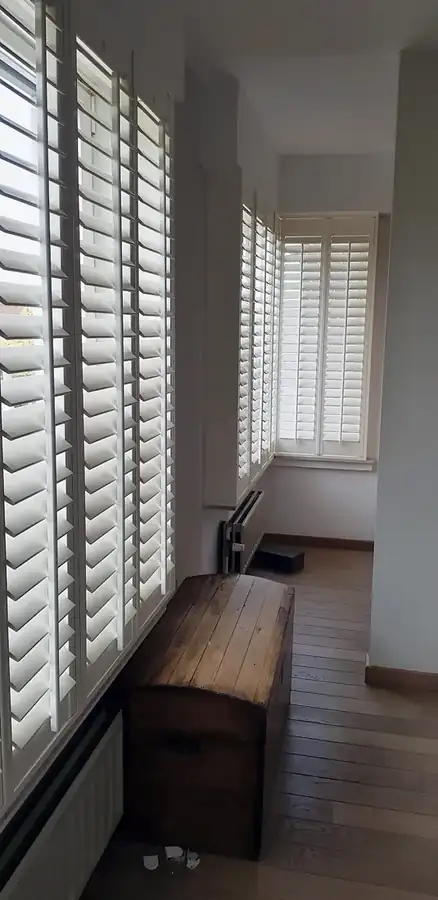


A corner window brings two window surfaces together. The shutters therefore need to fit each window individually, align logically at the corner and open without colliding. This requires a joint technical drawing covering both sides.
The corner is the fixed reference point
Even a slight deviation in the angle, reveal or frame line becomes immediately visible when two frames meet. Both sides are therefore built from the same measurement references. The connection must not bind and should remain visually balanced.
Panels open without touching each other
The folding or opening direction is determined by the available space on both sides. Furniture, window sills and radiator positions are also taken into account. Sometimes each window surface has a different panel layout to keep the corner practical to use.
Keep the tilt-and-turn window and handle accessible
When one part of the corner window can open or tilt, the shutter frame must provide sufficient clearance. A deep frame can create space for the window handle and tilt position, but the exact dimensions always depend on the actual window construction.
One consistent colour and louvre size
Although the technical solution may differ from one side to the other, the colour, louvre size and horizontal lines are coordinated. This makes the corner window read as one design rather than two separate window coverings.
Project in Antwerp
The Antwerp project combines a corner window and a straight window with 89 mm louvres, a central tilt rod, concealed hinges, additional light sealing and a deep frame for the tilt-and-turn window. It is a clear example of made-to-measure shutters bringing together several technical requirements.
Short answer
The essentials at a glance
With an unusual window shape, the geometry comes first. The shutter must follow the shape, remain technically stable and, wherever possible, preserve light control and use of the window.
Practical: Accurate technical surveying is essential for round, sloping and curved windows. Even a small measuring deviation is immediately visible in an unusual shape.
The choices that make the difference
Four points to assess before requesting a quotation
Exact contour
Curves, corners and sloping lines are measured at multiple reference points.
Panel and rail configuration
The internal lines must follow the shape logically and align with the straight section of the window.
Moving and fixed sections
Not every shaped segment can open or move in the same way; a combination is sometimes required.
Technical drawing
The shape is checked before production begins, as even a small deviation is immediately visible.
Avoid disappointment
Common mistakes when buying shutters
- Covering an unusual shape with a rectangle without good reason
- Using too few measuring points
- Requiring all shaped sections to move in the same way
From idea to installation
How a carefully managed made-to-measure process works
- Collect photos and approximate measurements of the windows.
- Compare material, colour, louvre size and operation.
- Have every window professionally measured at multiple points.
- Confirm the panel layout, technical details, price and schedule.
- Have your shutters installed, adjusted and explained to you.
In practice
See how these choices work in real homes
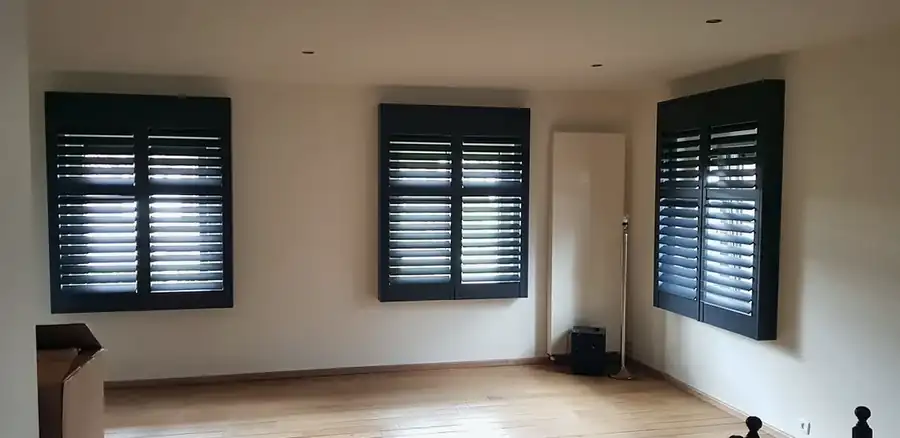
The projects below were measured and installed by DeVo. You can see real colours, window shapes and technical solutions.

Frequently asked questions
Can shutters be fitted around an internal corner?
Yes, provided both window surfaces are measured accurately and the panels have sufficient room to open. The corner connection is designed for each individual situation.
Can a tilt-and-turn window remain usable in a corner configuration?
Yes, for example with a deep frame or a different panel opening direction. The window handle, tilt position and opening clearance are checked before production.
Do both sides of the corner window need to have the same panel layout?
Not always. The geometry and everyday use are the determining factors, while the colour, louvre size and horizontal lines are coordinated wherever possible.
Why is a technical drawing important for this window shape?
Corners, curves and reference lines must be translated precisely into the frame, rails and louvres. Production only begins once the dimensions have been technically checked.
Is the same solution suitable for every window or room?
No. Made-to-measure corner-window shutters in which the lines, panels and everyday use are carefully coordinated. The window type, dimensions, installation position, material load and everyday use are assessed for each situation.
What does DeVo check during the professional site survey?
We take measurements at multiple points and check the frame, reveal, handles, opening direction, windowsill, available panel clearance, and the desired louvre and panel configuration, among other details.
How do louvre size and panel configuration affect the result?
They determine how many lines you see, how open the view through is and how practically the panels can open. The proportions in relation to the window matter more than one standard size.