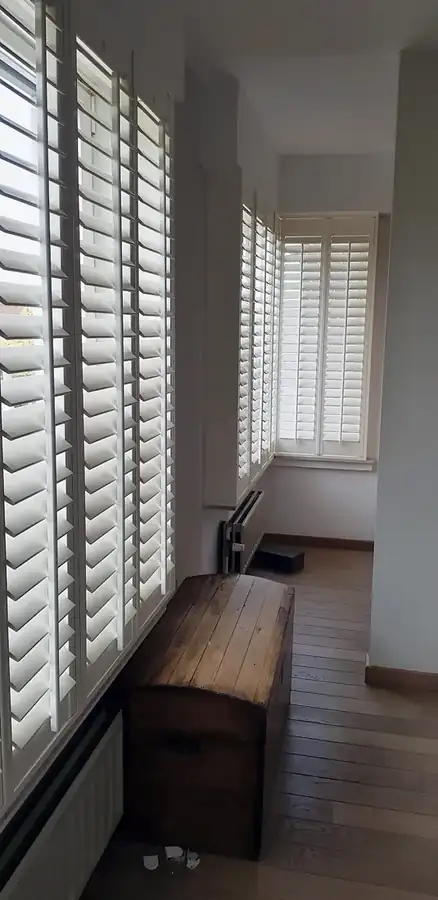


Shutters give you precise control over light, but they are not a completely light-tight system. Narrow lines of light may appear between the louvres, panels and frame. Accurate measurements, suitable connections and the right louvre position can nevertheless significantly reduce incoming light.
Where lines of light appear
Light finds the smallest openings around the louvres, side stiles, meeting rails and window details. A reveal that is not completely straight or a protruding window handle may also require additional clearance. As a result, light exclusion varies from one window to another, even within the same home.
The role of a cover strip
A cover strip can shield a direct gap at the frame or connection. In the Antwerp corner and tilt-and-turn window project, one was used to provide additional light reduction. The strip must, however, fit without obstructing operation or ventilation.
Louvre position and direction of sunlight
Fully closed louvres block the most direct light, but the best closing direction depends on where the sunlight is coming from. A different angle may be needed in the morning than later in the day.
Bedroom: discuss expectations in advance
For a bedroom, it is important to establish in advance whether strong light reduction is sufficient or complete blackout is required. In the latter case, an additional solution may be necessary, provided there is technically enough space for it.
Made-to-measure makes the difference
Accurate measuring and careful adjustment minimise unnecessary gaps. Even so, a shutter remains a movable product with functional clearance. Honest advice therefore covers both the strong light control shutters provide and the limits of complete blackout.
Short answer
The essentials at a glance
Shutters offer precise control over light and privacy and can improve comfort around the window. However, they do not replace structural insulation, complete blackout or external solar shading.
Practical: Think of shutters as a precise way to control light and privacy. Structural insulation, ventilation and complete blackout each require their own solution.
The choices that make the difference
Four points to assess before requesting a quotation
Window orientation
South- and west-facing façades require different solar control from north-facing windows.
Louvre position
The angle determines how much direct light, outlook and privacy there is.
Glazing and draught-proofing
The improvement in comfort also depends on the glazing, window frame and ventilation.
Use according to the time of day
A different position may be appropriate during the day, in the evening and when you are away.
Avoid disappointment
Common mistakes when buying shutters
- Making promises about building performance without measuring
- Using the same louvre position on every window
- Blocking ventilation completely
From idea to installation
How a carefully managed made-to-measure process works
- Collect photos and approximate measurements of the windows.
- Compare material, colour, louvre size and operation.
- Have every window professionally measured at multiple points.
- Confirm the panel layout, technical details, price and schedule.
- Have your shutters installed, adjusted and explained to you.
In practice
See how these choices work in real homes
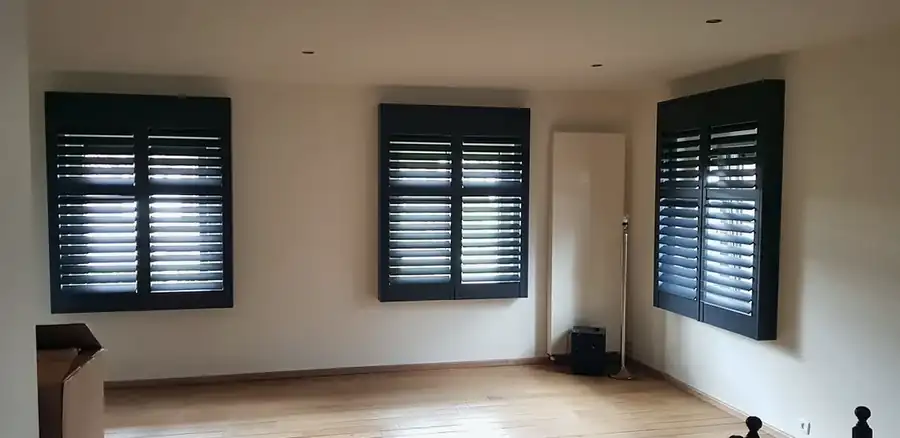
The projects below were measured and installed by DeVo. You can see real colours, window shapes and technical solutions.

Frequently asked questions
Do shutters provide complete blackout?
No. Shutters significantly reduce light, but narrow lines of light may remain visible along the louvres, panels and connections. Complete blackout often requires an additional solution.
Can a cover strip help prevent light gaps?
A suitable cover strip can reduce direct lines of light at a connection. Its effectiveness depends on the window shape, installation position and the clearance needed for operation and ventilation.
Does a black colour make a room darker than white?
Colour affects the ambience and reflection, but the greatest differences in light exclusion are caused by louvre position, fit, gaps and window construction.
Is the same solution suitable for every window or room?
No. Realistic information about light reduction, gaps, cover strips and the effect of installation and louvre position. Window type, dimensions, installation position, material load and everyday use are assessed for each situation.
What does DeVo check during the professional site survey?
We take measurements at multiple points and check the frame, reveal, handles, opening direction, windowsill, available panel clearance, and the desired louvre and panel configuration, among other details.
How do louvre size and panel configuration affect the result?
They determine how many lines you see, how open the view through is and how practically the panels can open. The proportions in relation to the window matter more than one standard size.
Can I compare materials, colours and operating options first?
Yes. During your consultation and in the Oud-Turnhout showroom, you can compare current collections, colour samples, louvre sizes and operating options side by side.